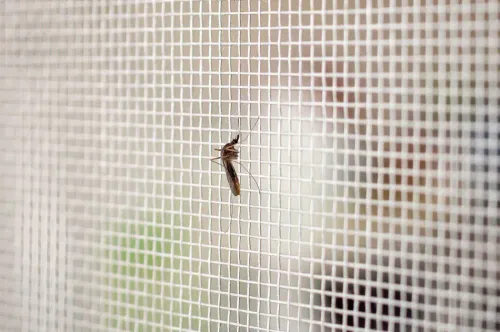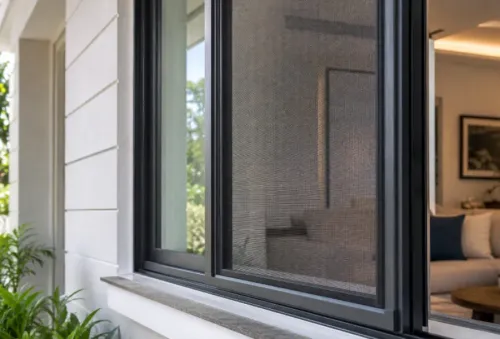

A screen that blocks mosquitoes can still make a room feel stuffy, collect dust quickly, or leave gaps around a door. By comparing aperture size, wire diameter, frame design, operating method, and installation clearances, you can specify a screen that protects the opening without creating new daily problems.
Key takeaways
- Specify opening size, thread diameter, weave, coating, and material.
- Choose fixed, sliding, hinged, or retractable screens for the opening’s traffic.
- Measure width, height, depth, and frame condition before requesting quotations.
- Inspect seals and ask for evidence matching your climate and use.
Start with the mesh specification, not the mesh count
Specify mesh openness before you specify the count. The procurement line should state clear opening size in millimetres, thread diameter, weave, coating, and material; “18 × 16 mesh” only describes the number of openings per linear inch. Wire diameter and coating thickness can make two screens with the same count perform very differently.
A useful material comparison is:
- Fiberglass: good visibility and daylight transmission, with moderate airflow and lower resistance to impact, pets, and abrasion.
- Aluminium: stiffer and more durable against handling, but thicker threads can reduce openness and eventually corrode in harsh conditions.
- Stainless steel: strong and long-lasting, though its finer performance depends on the specified wire diameter and finish.
For plain square weave, estimate open area as (opening ÷ (opening + wire diameter))². A small increase in thread diameter cuts free area disproportionately, reducing airflow and making the screen look darker. Finer openings block smaller insects but collect dust faster.
18 × 16 mesh suits general insect protection when ventilation matters. Choose 20 × 20 mesh for no-see-ums and biting midges, accepting greater airflow resistance and lower visibility. Ask for the actual aperture, not a marketing label.
The frame also determines service life: oversized panels, loose spline, weak corners, or thermal movement can bow the screen and open edge gaps. ASTM D3656 describes woven insect-screen characteristics; it is not an airflow or pressure-drop rating.
Match the screen system to the opening and its traffic
Choose the system by how the opening moves and how often people pass through it. A mesh that works well on a quiet window can become damaged or annoying on a busy doorway.
| Option | Best match | Watch for |
|---|---|---|
| Fixed screen | Casement windows, fixed windows, and uPVC frames opened rarely | It needs a firm perimeter seal and enough clearance for the handle and sash. |
| Roll-down mesh | Windows or balcony openings that need occasional access | Check spring tension, side-channel alignment, and whether the bottom bar closes against the sill. |
| Pleated mesh | Large balcony doors, sliding doors, and barrier-free thresholds | Confirm stack space and bottom guidance; dirt in the track can stop smooth travel. |
| Hinged screen | A frequently used single door | Specify continuous perimeter seals and reliable self-closing, or insects will follow every incomplete closure. |
| Sliding screen | Wide doors and large openings with a compatible track | Require overlapping meeting stiles, controlled bottom clearance, and tracks that prevent lateral escape. |
| Velcro screen | Temporary, rented, or low-cost window protection | Velcro screen limitations and uses include weaker edge sealing, adhesive failure, and inconvenient removal in heavy traffic. |
| Barrier-free system | Doorways where a raised bottom track creates a trip hazard | Check how the lower seal closes without a threshold obstruction. |
For a pleated mesh comparison, test handle clearance, stacking width, and threshold access together; the smallest opening dimension can decide the design. A fixed screen suits a quiet window, not a balcony door used fifty times a day. No system compensates for a damaged edge, frame gap, open threshold, or poorly aligned overlap.
Measure the opening before you compare quotations
A quotation is only comparable after a site measurement records the opening and every obstruction around it. Measure width at the top, middle, and bottom, then use the smallest figure; measure height at both sides and the centre, again using the smallest figure.
- Record the reveal depth from the room-side face to the outer edge of the frame.
- Measure frame clearance around the proposed screen, including the space needed for rollers, hinges, magnets, handles, and fixing brackets.
- Note whether the sill is level, sloped, raised, recessed, or interrupted by a track.
- Mark the handle position and swing path; an inward-opening and outward-opening doors need different screen locations and clearances.
- Record the required overlap at meeting rails, side jambs, and the threshold so insects cannot use a gap as a bypass.
- Photograph curtains, blinds, grills, window hardware, drainage slots, and nearby furniture that could obstruct operation.
- State the opening direction and whether the screen must sit inside or outside the existing frame.
| Measurement | Record | Why it prevents errors |
|---|---|---|
| Width and height | Smallest measurement at three points | Stops a frame binding in a tapered opening |
| Reveal depth | Usable depth in millimetres | Confirms the cassette, track, or hinge will fit |
| Sill level | Flat, sloped, raised, or absent | Determines threshold sealing and track alignment |
| Clearance and hardware | Handle, lock, grill, curtain, and blind positions | Prevents collisions during use |
| Overlap and direction | Meeting overlap, swing direction, and closing path | Prevents an open edge or unusable door screen |
Inspect the seal, then plan for cleaning and wear
A sound installation has a gap-free perimeter seal, with no light visible at corners, frame-to-wall joints, meeting rails, or the bottom edge. Press lightly along the mesh: it should stay tensioned without bowing, while spline and Velcro retention should hold the fabric firmly instead of allowing edge release.
Open and close a door or window several times. Hinged doors need reliable self-closing and continuous sealing; sliding panels need overlapping meeting stiles, controlled bottom clearance, smooth tracks and aligned guides. A damaged corner, loose spline, open threshold, or misaligned guide becomes the largest effective opening, regardless of the mesh specification.
Match upkeep to the exposure:
- Pets and children: inspect claw tears, pushed-out corners, loose fasteners, and impact damage monthly; repair mesh before the opening spreads.
- High wind and strong sunlight: check for frame bowing, brittle fabric, and edge release each season; replace distorted retention parts rather than stretching the mesh tighter.
- Construction dust: vacuum with a soft brush, then wipe with mild soapy water after nearby work ends.
- Kitchen grease: remove the screen if possible and wash it regularly; grease traps dust and reduces airflow.
- Heavy daily traffic: clear grit from tracks, confirm closure after every adjustment, and schedule dust cleaning and mesh repair when the panel drags or fails to meet its seal.
Ask the supplier for evidence that matches your use
Before ordering, ask for evidence tied to your opening, not a generic catalogue claim. Request a sample mesh and record aperture size in millimetres; “18 × 16” alone cannot establish insect exclusion or airflow. Ask for the frame profile and colour, corner joints, spline or gasket, overlap, and a drawing showing clearances.
Compare quotations against this evidence:
| Item | Ask for | Reject or query if |
|---|---|---|
| Airflow | Pressure-drop results across the complete installed assembly at several face velocities, with test area, mounting orientation, mesh condition, and hardware stated | It gives one air-change figure or cites ASTM E283 as a mesh airflow rating |
| Material | ASTM D3656 woven screening specification, with material, coating, and aperture tolerances | It treats ASTM D3656 as a measured airflow or pressure-drop result |
| Fit | Site measurement sheet and installation sketch showing wall joints, corners, sill, handles, and overlap | It measures only the nominal opening |
| Service | Written warranty period, exclusions, response time, adjustment visits, and prices or lead times for spline, mesh, rollers, magnets, and frames | Damage, sag, or poor sealing has no stated remedy |
Have the installer confirm who corrects rubbing, loose seals, gaps, or a door that will not latch after fitting. Delmen Nets 9650012393 should document those commitments rather than leave them as verbal assurances.
Choose another product for fall prevention, bird safety, pet containment, or impact protection; insect mesh is not a structural barrier.
Related products
 | Pleated Mesh Systems Manufacturer and Supplier in Gurgaon Delmen Nets is the manufacturers and the suppliers of an excellent and superior quality of Pleated Mesh Systems... View product → |
 | Insects Screens System Manufacturer and Supplier in Gurgaon We are leading manufacturer of Insect Screen Systems from Gurgaon. View product → |
Frequently asked questions
What mesh specifications should you compare besides mesh count?
Compare clear opening size in millimetres, thread diameter, weave, coating, and material. The same mesh count can produce different airflow, strength, and visibility when wire diameter or coating changes.
How do you choose a mosquito screen system for an opening?
Match the system to the opening and its traffic. Consider whether people use the door frequently, whether the screen must slide or hinge, and how much clearance the frame provides.
What should you measure before requesting mosquito mesh quotations?
Measure the opening’s width, height, and available frame depth. Check whether the opening is square, inspect the existing frame, and record obstructions such as handles, tracks, and window grilles.
How should you inspect and maintain a mosquito mesh screen?
Check the perimeter seal, corners, joins, brush strips, magnets, and frame alignment. Remove dust with a soft brush or low-pressure vacuum, then repair tears and worn seals before insects can pass through.
What evidence should you request from a mosquito mesh supplier?
Ask for a specification sheet that identifies material, weave, opening size, thread diameter, coating, dimensions, and installation details. Request test or performance evidence that matches your opening, exposure, cleaning routine, and expected traffic.
Related products
 | Barrier free Mesh Systems Manufacturer and Supplier in Gurgaon Delmen Nets are Manufacturer & Supplier of excellent quality Barrier Free Doors Mesh Systems to our valuable... View product → |
 | Mosquito Nets For uPVC Doors Manufacturer and Supplier in Gurgaon Top Grade Mosquito Nets For uPVC doors manufacturers in Gurgaon, Haryana. View product → |
 | Velcro Mesh Systems Manufacturer and Supplier in Gurgaon Manufacturer of Velcro Mesh Systems - Velcro Net offered by Delmen Nets are of high quality, It protect from the... View product → |